Home of the Finesse Fire Index, Pitching History & Analysis, and More
Finesse and Fire is a baseball blog and experimental lab dedicated to exploring the spectrum between finesse and heat on the Major League mound—anchored by the prototypes Greg Maddux and Randy Johnson.
Rooted in a lifelong passion for pitching craft and baseball history, the site introduces the Finesse Fire Index (FFI), a metric evaluating where historic and active pitchers fall on the spectrum. While this blog serves as an open lab—leveraging AI for complex statistical analysis and content generation—it feeds into upcoming long-form books and articles that are entirely human-written. Finesse and Fire bridges classic baseball reverence with modern analytics to uncover what truly makes a pitcher dominant.
Home of the FFI Index & More Home of the FFI Index & More Home of the FFI Index & More Home of the FFI Index & More
Home of the FFI Index & More Home of the FFI Index & More Home of the FFI Index & More Home of the FFI Index & More
Finesse: Greg Maddux
Greg Maddux’s fastball sat in the high 80s. That’s it. On any given night there were twenty guys in the league who threw harder, and most of them were out of baseball long before he was done winning. What he had instead was movement, and a feel for where the ball was going that bordered on eerie. His two-seamer started at a right-handed hitter’s hip and ran back over the inside corner at the last instant, and guys would be halfway out of the box when they heard strike three. Hitters called it the Invisiball. He worked in inches. By the middle innings the corners of the plate belonged to him, and everyone in the park knew it, including the umpire.
The stuff was good. The brain was unfair. Nobody prepared like Maddux, and teammates swore he could call where a ball was going to be hit before the pitch left his hand, then be standing there waiting for it. He worked fast, wasted almost nothing, and made 95-pitch complete games look routine. Here’s my favorite number of his career, and honestly it’s the whole argument for this blog in one stat: 3,371 strikeouts. From a guy who barely cracked 92. Command, movement, and a genius for the game will miss plenty of bats on their own.
Then there’s the resume. 355 wins. Four straight Cy Youngs from ’92 to ’95. ERAs of 1.56 and 1.63 in ’94 and ’95, right in the heart of the steroid era, when half the league was turning into video game characters and he was carving them up with an 89-mph fastball. And it lasted forever, because there was nothing to lose. Velocity goes. Craft doesn’t. That’s why Maddux is my finesse prototype. He’s not just the best example of the type. He basically is the type.
Fire: Randy Johnson
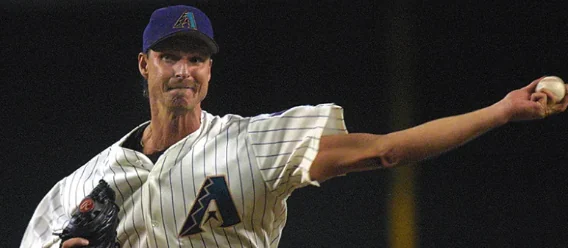
Randy Johnson was 6′10″ and threw a hundred miles an hour, and somehow neither number captures what it was like to watch him. The ball seemed to leave his hand about 54 feet from the plate. Left-handed hitters wanted no part of him, and honestly, who could blame them. The enduring image of early-’90s baseball might be John Kruk at the ’93 All-Star Game, bailing out of the box on a fastball over his head and laughing about it, because laughing beat the alternative. And the slider was worse. It started at your ear and finished at your shoelaces. With Johnson, intimidation wasn’t a side effect. It was the game plan.
The wild thing is that for years, nobody could aim that fire, including Johnson himself. He led the league in walks three straight seasons in the early ’90s and looked like he might walk himself out of the sport entirely. Then the mechanics clicked around 1993, and the scariest pitcher in baseball became its most unfair one: same 100-mph fastball, same ankle-breaking slider, now showing up in the strike zone on purpose. He never became a control pitcher. He just learned to point the cannon.
The numbers barely look real. 4,875 strikeouts, second only to Nolan Ryan, and the highest strikeout rate ever. Five Cy Youngs. A 20-strikeout game. A perfect game at age 40, when most fireballers are five years into retirement. And the 2001 World Series, where he won three games against the Yankees and took home co-MVP. Maddux is proof that craft lasts. Johnson is proof that real fire never burns out — it just learns where to aim. That’s why he anchors the fire end of the FFI. If you’re measuring power pitching, you start with the guy who made power the whole story.
FFI bridges classical baseball history (where fans understood pitchers by “Fire” or “Finesse”) with 21st-century spatial tracking data (velocity, extension, and movement vectors).
How does it compare to ‘vs Power’ and ‘vs Control’?
Most systems force a choice: a pitcher is either a power arm or a control artist. FFI replaces that either/or with a 0–100 continuum built on four weighted pillars — adjusted velocity, extension, era-adjusted strikeout dominance, and walk suppression. That’s how a pitcher with elite heat and elite command lands in the middle instead of being forced into one camp.
It’s quite amazing how useful something suddenly becomes once it can be quantified. FFI not only allows for the comparison of individual pitching styles amongst pitchers but also how the styles of individual pitchers evolve over time. It also enables the comparison of pitchers collectively from one year/decade/era to the next. And these examples represent the tip of the iceberg.
Is it used by MLB or SABR?
Not yet. At least not in any kind of official capacity to my knowledge.
When was it created?
August of 2026.
What is considered a good FFI score?
There are no good or bad FFI scores. The Finesse Fire Index simply provides a continuum between pure ‘finesse’ pitchers (0 to 33), pure ‘fire’ pitchers (67–100), and those falling somewhere in the middle (34–66).