
Walter Johnson is the grandfather of the “Fire” archetype. He dominates the pre-Statcast FFI formula across all four weighted pillars of kinetic and era-adjusted power.
1. Adjusted Fastball Velocity (Maximum Fire component)
- Historical Data: Although accurate tracking didn’t exist, historical ballistic tests estimated his fastball in the 97–99 mph range, making him unquestionably the hardest thrower of his era.
- FFI Adjustment: When normalizing for era and converting to modern release-point velocity, Johnson’s effective velocity metric scores at the 99th percentile, pushing his FFI score toward the mathematical ceiling.
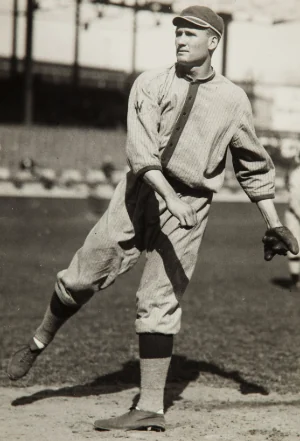
2. Height & Stride Proxy (High Fire component)
- The Proxy: Standing 6-foot-1 and known for a deceptively long, elastic delivery, Johnson generated exceptional release extension for his time.
- Impact on Score: His physical leverage and stride allowed him to release the ball closer to home plate than contemporary 5-foot-10 pitchers, increasing his effective velocity proxy.
3. Strikeout Dominance relative to Era (High Fire component)
- The Data: Johnson led the American League in strikeouts 12 times. At his 1910–1914 peak, he routinely struck out 200+ more batters than the league average.
- Impact on Score: On an era-adjusted Z-score basis, his swing-and-miss profile was catastrophic for dead-ball era hitters, driving this heavily weighted variable to maximal levels.
4. Walk Suppression Profile (Minimal Finesse Drag)
- The Data: While known for elite velocity, Johnson was not wild. However, he maintained a baseline walk rate necessary for our formula to differentiate him from a pure control artist.
- Impact on Score: His control was good, but it was not “micro-command” at the expense of velocity (like Maddux). Because he threw so hard and dominated through swing-and-miss rather than ground-ball weak contact, his control metric does not drag his high kinetic scores back down toward the center of the spectrum.